A kind of manifesto (short version)
Enterprise-architecture is dead; long live the architecture of the enterprise? Or something like that, anyway…
Time for a kind of manifesto, I guess?
As is perhaps too usual in my writing, the full-length version of the ‘manifesto’ ended up, uh, kinda long… So here’s a short-form summary, consisting only of the highlighted statements in that ‘manifesto’: if you need more detail, refer back to the full-length version.
One point I perhaps first need to clarify: By ‘enterprise‘ (or ‘shared-enterprise’) here I do not mean the organisation-as-enterprise, but something several orders-of-magnitude larger – that which the organisation chooses (if only by default) to orbit:
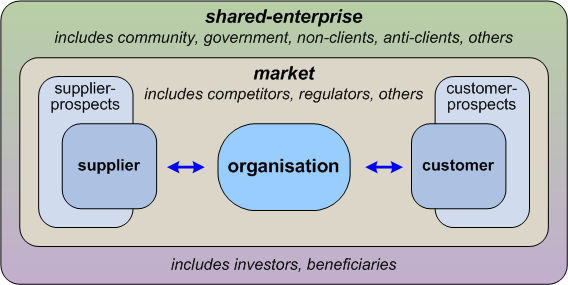
Anyway, on with the show:
— We create an architecture for an organisation, about a broader shared-enterprise.
— The shared-enterprise is not, and never can be, under our organisation’s control.
— Recursion is an inherent part of the picture here, at every scale.
— In a viable architecture of the enterprise, everywhere and nowhere is ‘the centre’, all at the same time.
— The shared-enterprise is perhaps best-understood as an ‘ecosystem-with-purpose’.
— Everything within the shared-enterprise depends on everything else.
— No item in the enterprise is inherently ‘more important’ or ‘less important’ than any other.
— The purpose and reason for ‘the architecture of the enterprise’: that things work better when they work together, on purpose.
— People and their needs are the ultimate start-point and end-point of all concerns in the shared-enterprise.
— Technology is only ever an enabler – never ‘the sole centre’.
— We must always place people first in the enterprise – not the technology.
— We need to rethink how work itself is organised, within the organisation and beyond.
— Volatility, uncertainty, complexity and ambiguity are characteristics that every architecture must address.
— The architecture of the enterprise is inherently contextual.
— Architecture sits at the intersection of structure and story.
— Architectural methods should support and be applied to the enterprise of ‘the architecture of the enterprise’ itself.
— Work for the architecture of the enterprise takes place over multiple, overlapping timescales.
Next: what does this mean in practice? – perhaps especially for my own future work?
Watch This Space, I’d suggest? 🙂
Thank you for this very useful summary, Tom.
I have included your graphic in my post “What is an enterprise ecosystem, and why does it matter?”(http://www.jackmartinleith.com/enterprise-ecosystem) with a link to this item.
One question: Would you clarify the difference between customer-prospects and non-clients please?
Good to see you’re soldiering on with EA and AE.
Thanks, Jack.
“Would you clarify the difference between customer-prospects and non-clients please?”
Sure. A customer-prospect is someone who could become an active client; a non-client is someone who is a stakeholder in the overall shared-enterprise, but either wouldn’t or couldn’t be a client.
Some simple examples of non-clients:
— someone who’s too old or too young (for example, you do dance-parties for 18-25s: people of any age may like to dance – they’re in the ‘let’s dance!’ shared-enterprise – but your own products/services place an age-constraint on who you deliver to/for)
— someone who’s the wrong sex (for example, obstetric services: fathers, grandparents, children may all be involved, but they’re not clients for the services)
— someone who’s in a different location that you don’t or can’t serve
The question is Tom . . . What is the Enterprise? I believe we have to start from the proposition that the Enterprise of the Future is fundamentally changed; and some of your assertions are right on. But we need to understand that future shape, model it, and we can talk about how to architecture for it. http://www.slideshare.net/DSprott/ea-30